

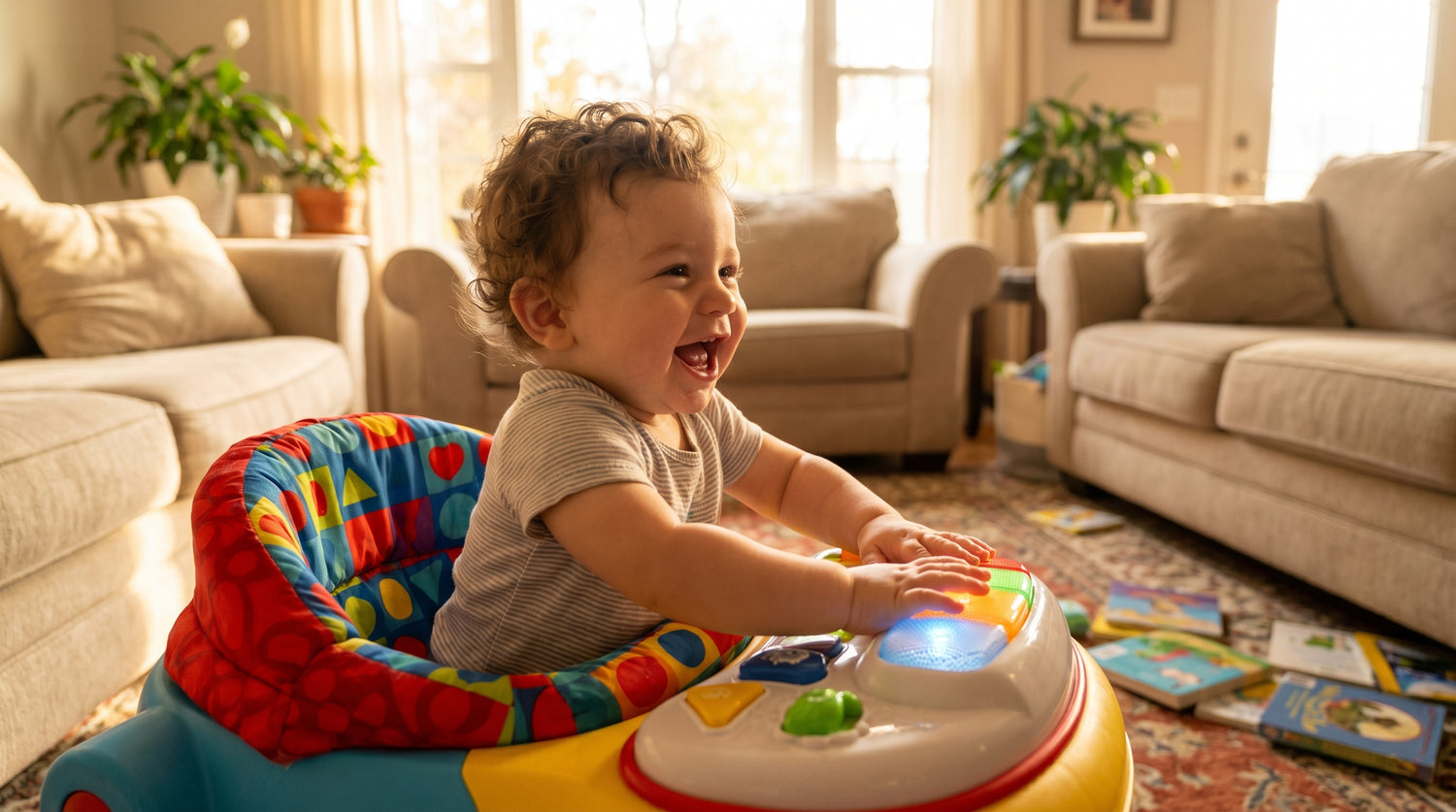
Baby walkers are one of the most polarising items in the parenting world. Loved by many parents for the joy they bring developing babies, they've also been the subject of safety concerns for decades. Here's a clear-eyed look at what the research actually says — and how to choose a walker that's genuinely safe.
Why Are Walkers Controversial?
Traditional wheeled baby walkers gained a poor safety reputation primarily because of stair accident risk. When a baby in a wheeled walker reaches a staircase or step, the momentum of the wheels can carry them over the edge before a parent can intervene. This led to significant injury rates in the era before stair-gate adoption became standard.
Today, with stair gates considered standard equipment in homes with young children, and with modern walkers designed with explicit safety features, the risk profile has changed considerably.
What Makes a Walker Safe?
Modern walker design has addressed the key historical risks:
Anti-rollover (stop) mechanism
The most important safety innovation in modern walkers is the anti-rollover or step-stop mechanism. This feature detects when the front wheel encounters a drop (such as a stair edge) and automatically locks the wheels, preventing the walker from continuing over the edge.
The First Steps™ Baby Walker Anti Rollover features a precision-engineered braking system that activates the moment a step is detected — giving parents a critical margin of safety even in moments of distracted supervision.
Wide base design
A wide-stance base is harder to tip laterally. Look for walkers where the base extends significantly beyond the seat in all directions — particularly important for babies who lean enthusiastically to reach objects.
Seat safety
The seat should be well-padded and positioned at the correct height for the baby's leg length, allowing their feet to touch the floor with slight knee bend.
Age and Developmental Readiness
Walkers are appropriate when babies can support their own head and have developed some lower body strength — typically around 6 months, but every baby is different. Signs of readiness include:
- Good head and neck control
- Sitting with minimal support
- Weight-bearing on legs when held upright
- Active interest in movement and exploration
Supervision Always Matters
Even the safest walker is not a substitute for parental supervision. Anti-rollover mechanisms add a critical safety margin but are not infallible. Always ensure the floor area is clear of obstacles, stair gates are firmly in place, and a responsible adult is nearby.
The First Steps™ Advantage
The First Steps™ Anti Rollover Baby Walker combines the best current safety engineering with an engaging design that babies love. It's the walker you can feel genuinely confident about.



Dejar un comentario
Este sitio está protegido por hCaptcha y se aplican la Política de privacidad de hCaptcha y los Términos del servicio.